Introduction
Demolition contractors face risks that most businesses never encounter.
You may be working around unstable structures, heavy equipment, neighboring buildings, underground utilities, hazardous materials, subcontractors, falling debris, and active jobsites—all while working under contracts that can impose very specific insurance requirements.
That means buying insurance for a demolition company isn’t as simple as purchasing a standard contractor policy.
The right insurance program needs to consider what you demolish, how you perform the work, where you work, who works for you, what equipment you operate, whether you subcontract, and what your contracts require.
At Apollo General Insurance Agency, demolition isn’t an unfamiliar class of business. Apollo has developed specialty insurance programs specifically for demolition contractors, including residential tear-downs, commercial demolition, and interior strip-outs.
So, what insurance should a demolition contractor consider?
Let’s break it down.
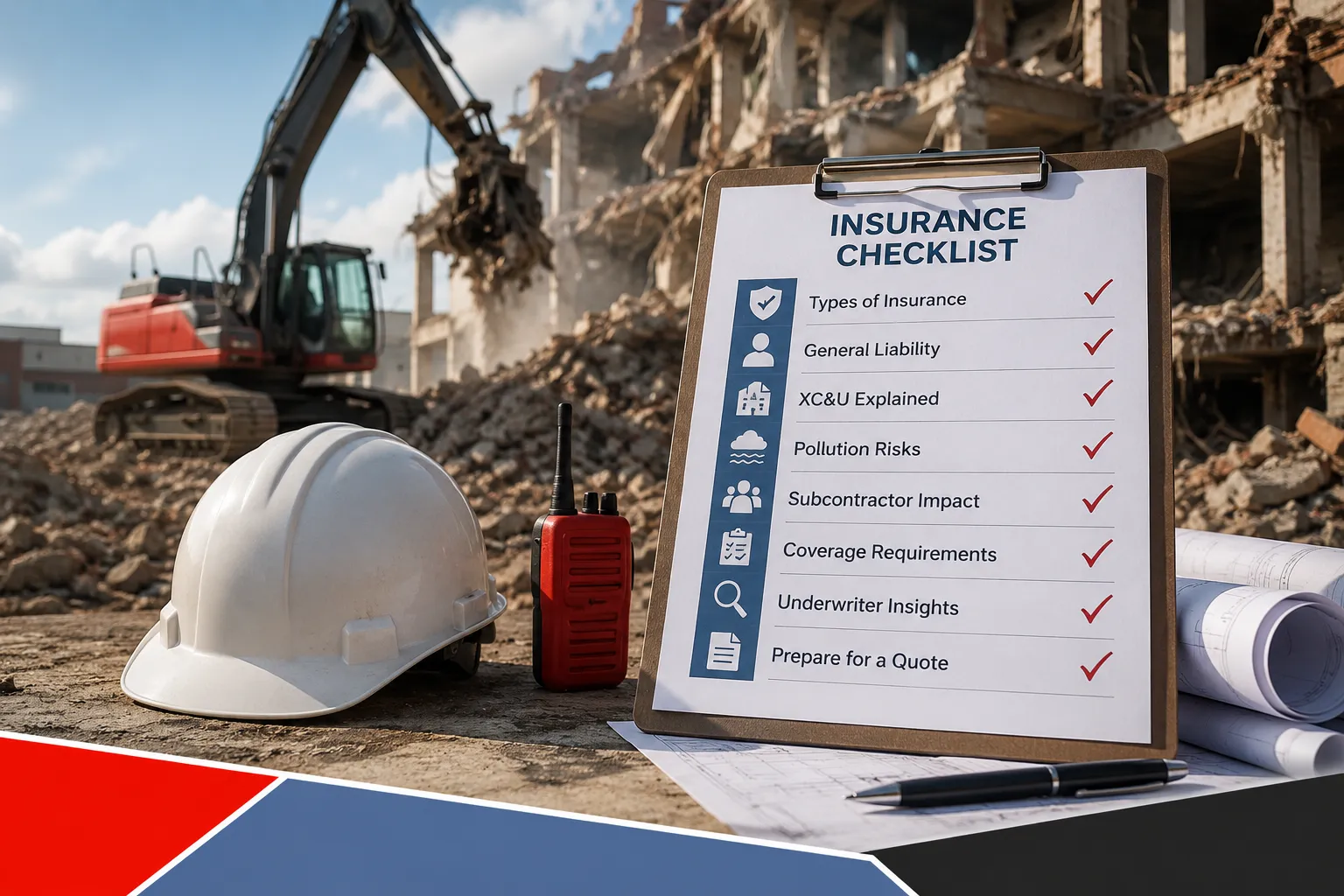
What You’ll Learn
- What types of insurance demolition contractors commonly need
- Why general liability coverage is particularly important for demolition
- What XC&U means and why demolition contractors should understand it
- How pollution risks can affect demolition projects
- Why subcontractors can affect your insurance program
- What coverage may be required before bidding a project
- What underwriters may want to know about your demolition company
- How to prepare before requesting a demolition insurance quote
Why Is Demolition Contractor Insurance Different?
A painter, electrician, and demolition contractor can all be considered contractors.
Their risks aren’t remotely identical.
Consider what could happen during a demolition project.
A wall could fall in an unexpected direction.
Heavy equipment could damage neighboring property.
An underground utility could be struck.
Dust or contaminants could create environmental concerns.
An employee could be injured.
A subcontractor could cause damage.
A company truck could be involved in an accident.
Equipment could be damaged or stolen.
Then there is the structure itself.
Demolition contractors are intentionally dismantling, cutting, breaking, crushing, or removing buildings and building components. Activities that would be unusual losses for many businesses are simply part of the everyday work environment in demolition.
Insurance therefore needs to be evaluated around the contractor’s actual operations.
1. Commercial General Liability Insurance
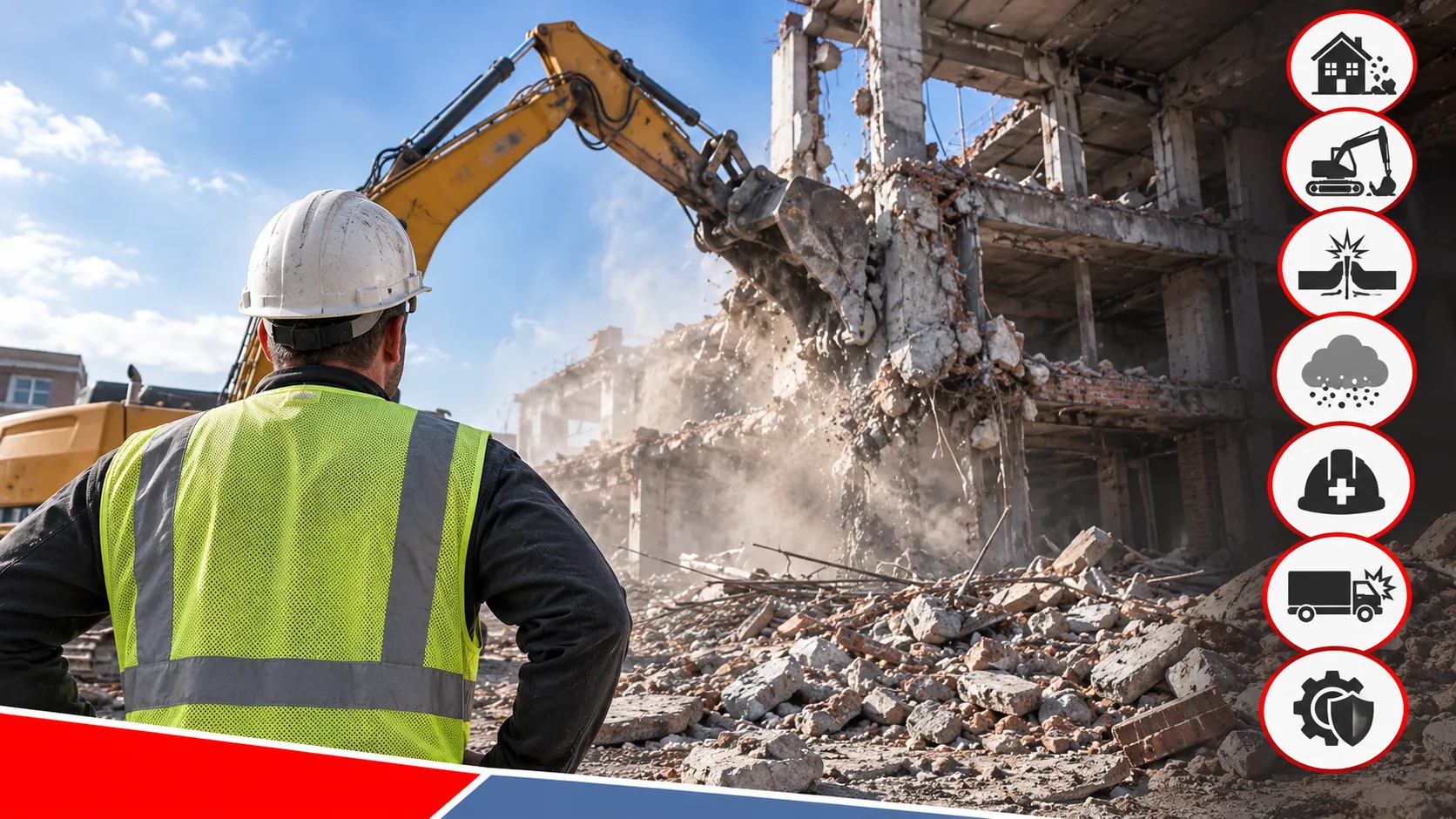
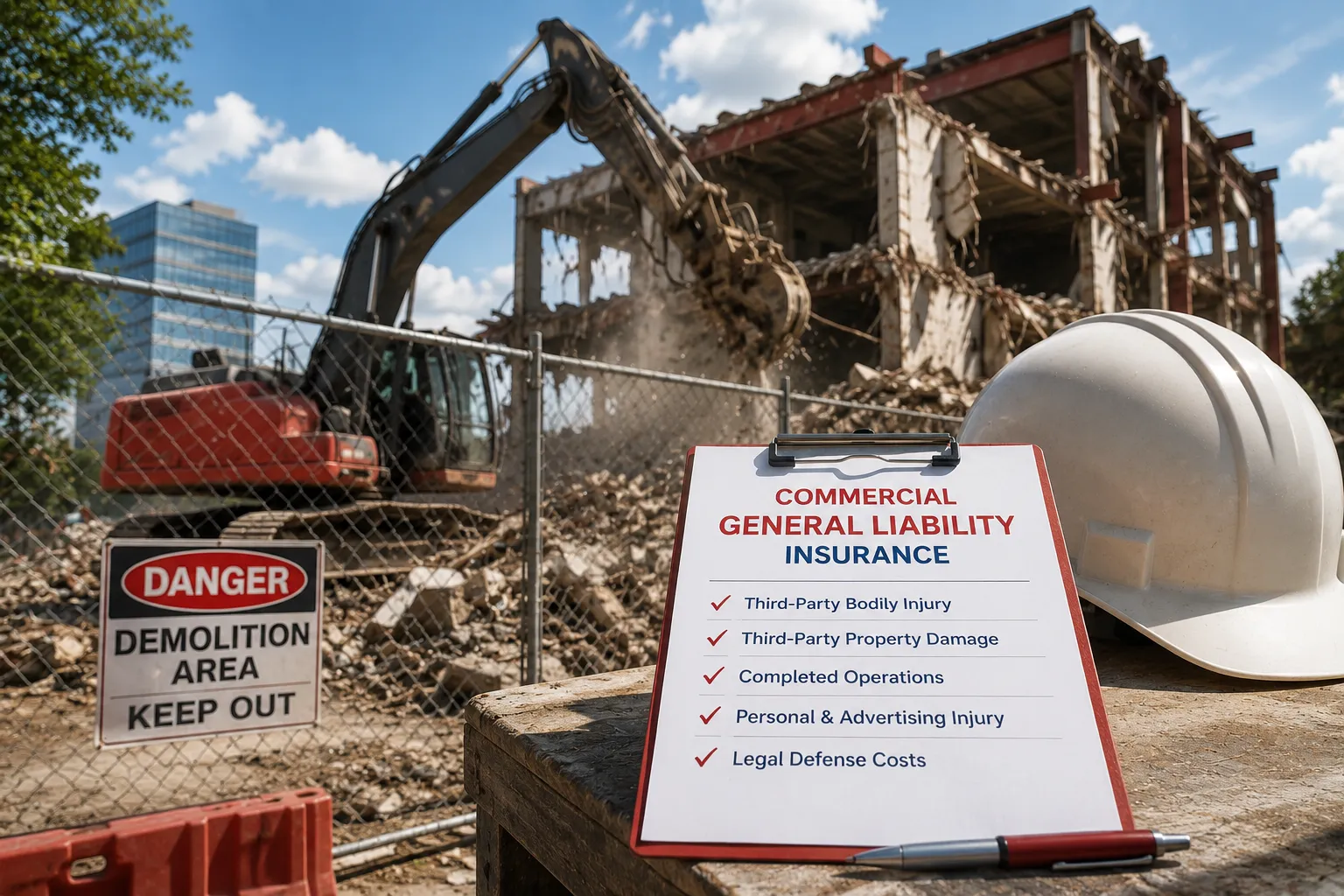
Commercial general liability is one of the foundational coverages for demolition contractors.
General liability insurance can respond to certain claims involving third-party bodily injury or property damage arising from covered operations, subject to the terms, conditions, limitations, and exclusions of the policy.
For example, imagine a demolition contractor is removing part of a commercial structure and debris damages neighboring property.
Or a third party is injured around the jobsite.
Those are the types of liability exposures that make general liability coverage so important.
But demolition contractors need to look beyond simply asking:
“Do I have general liability insurance?”
The better question is:
“Does my general liability policy properly contemplate the demolition work I’m actually performing?”
Not every contractor policy is designed for demolition operations.
2. XC&U Coverage
If you’re in demolition, this is an insurance term worth knowing.
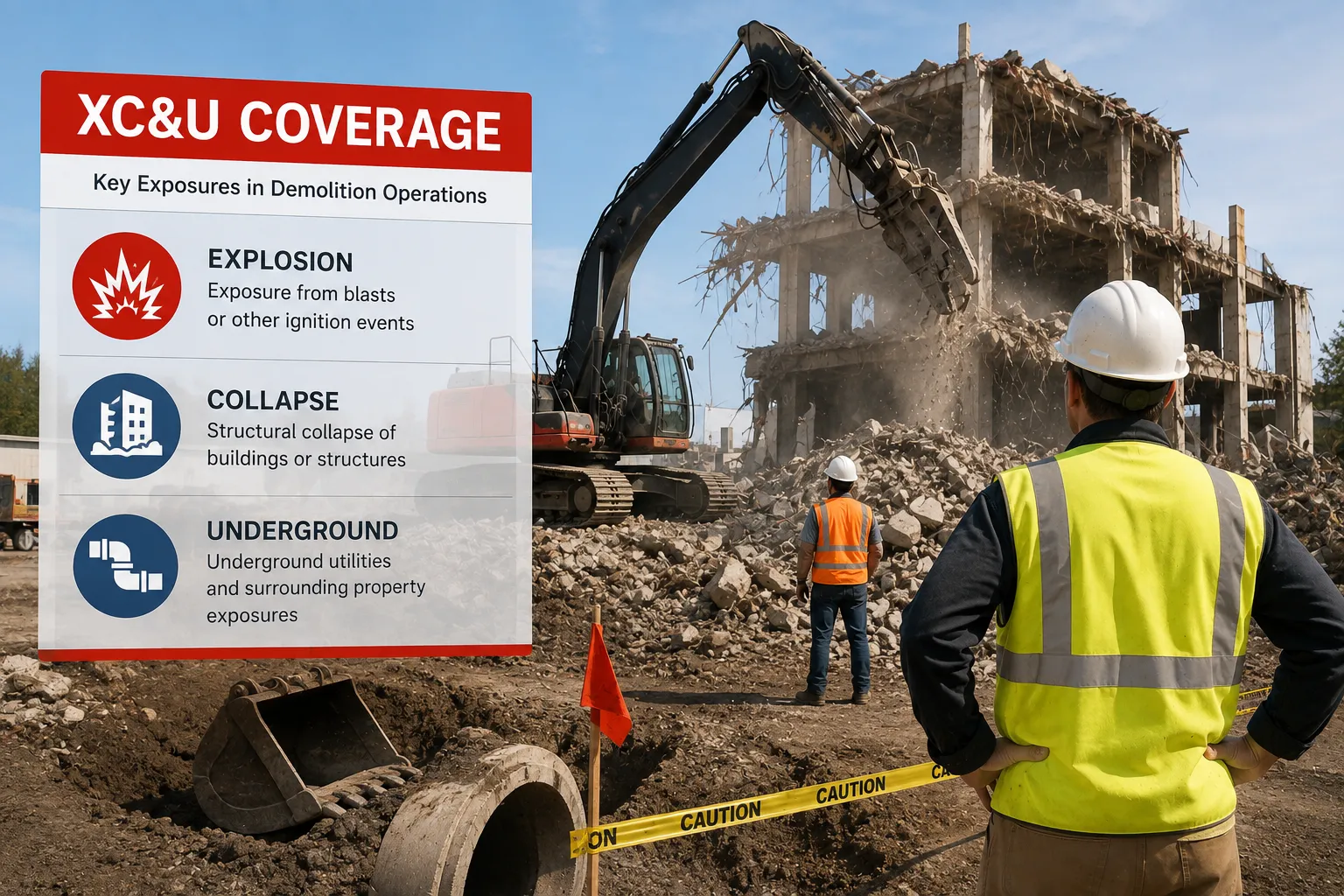
XC&U refers to:
Explosion
Collapse
Underground
These exposures can be particularly relevant to demolition and excavation-related operations.
For example, demolition work may involve structural collapse as part of the intended operation or create exposure to underground utilities and surrounding property.
A contractor should therefore understand whether exclusions or limitations related to these exposures exist within a proposed policy.
Apollo’s demolition contractor program includes options addressing XC&U exposures, making this an important area to discuss when evaluating coverage.
Never assume that because you have a general liability policy, every demolition-related exposure is automatically covered.
3. Workers’ Compensation Insurance
Demolition is physical work performed in environments where employees may encounter heavy machinery, debris, heights, unstable surfaces, tools, dust, noise, and numerous other hazards.
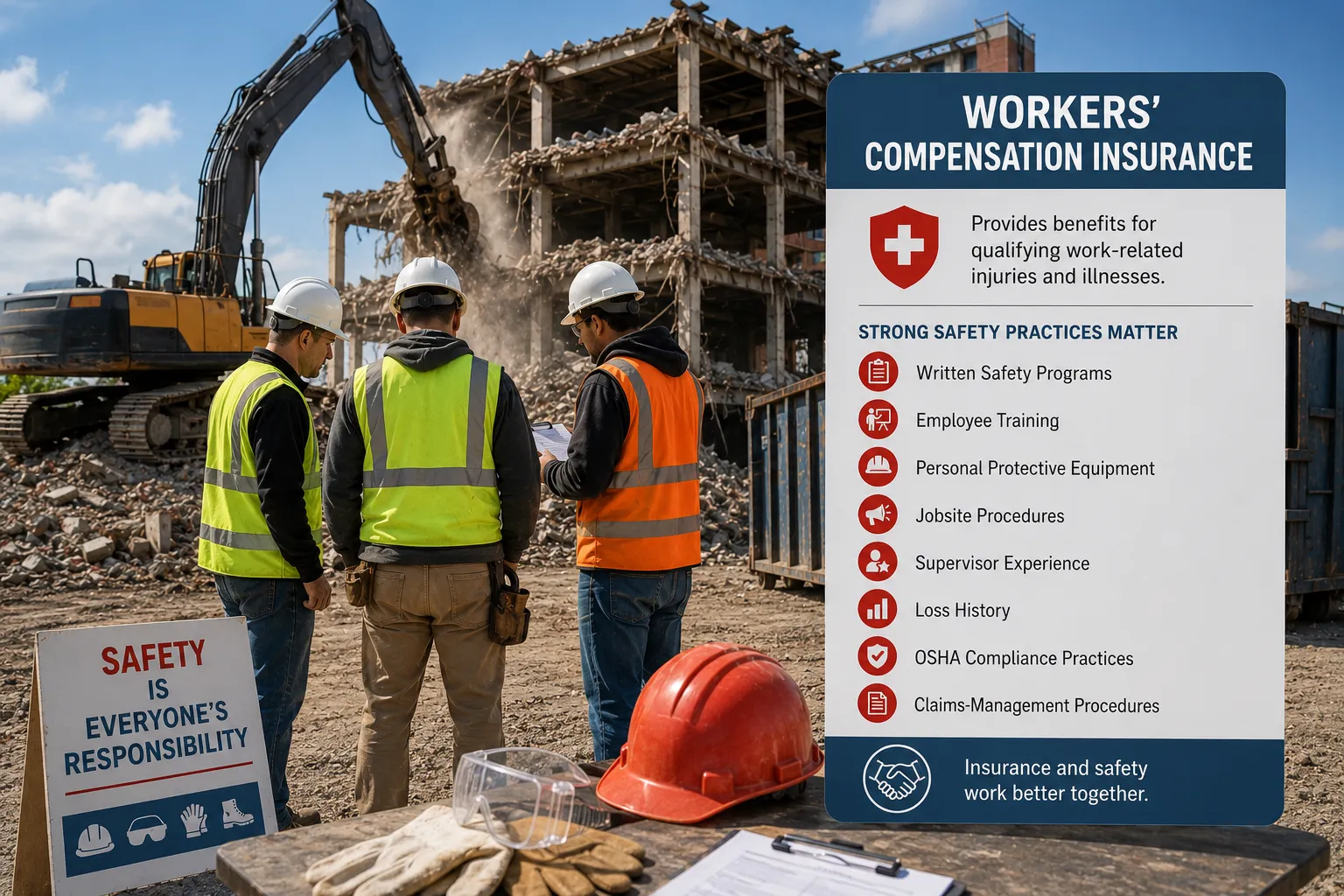
Workers’ compensation is designed to provide benefits for qualifying work-related employee injuries and illnesses in accordance with applicable law and policy terms.
Requirements vary depending on the state and circumstances of the business.
For demolition companies with employees, workers’ compensation should be an important part of the overall insurance discussion.
Underwriters may also be interested in how your company manages employee safety.
That can include:
- Written safety programs
- Employee training
- Personal protective equipment
- Jobsite procedures
- Supervisor experience
- Loss history
- OSHA compliance practices
- Claims-management procedures
Insurance doesn’t replace a strong safety culture.
The two should work together.
4. Commercial Auto Insurance
Demolition companies frequently operate vehicles for much more than getting employees to work.
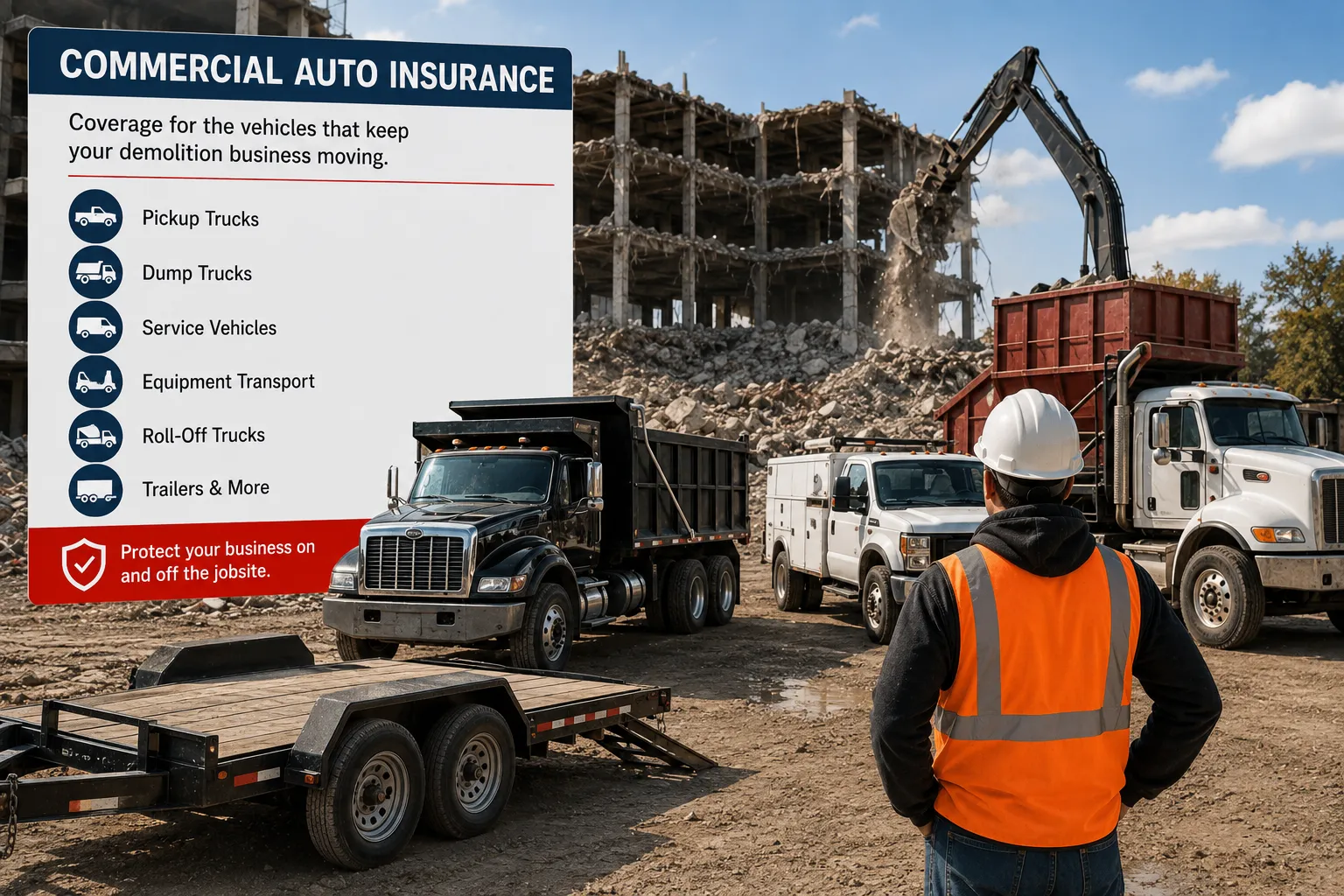
You may have:
- Pickup trucks
- Dump trucks
- Service vehicles
- Trailers
- Equipment transport vehicles
- Roll-off trucks
- Other commercial vehicles
Personal auto insurance generally isn’t designed to cover vehicles being used for many commercial operations.
Commercial auto insurance can provide liability and other selected coverage for qualifying business vehicles and operations, depending on the policy.
This becomes especially important when employees regularly drive company vehicles or equipment and debris are transported between jobsites.
5. Contractors Pollution Liability
Pollution exposure deserves special attention in demolition.
Older structures can contain materials or substances that require careful handling.
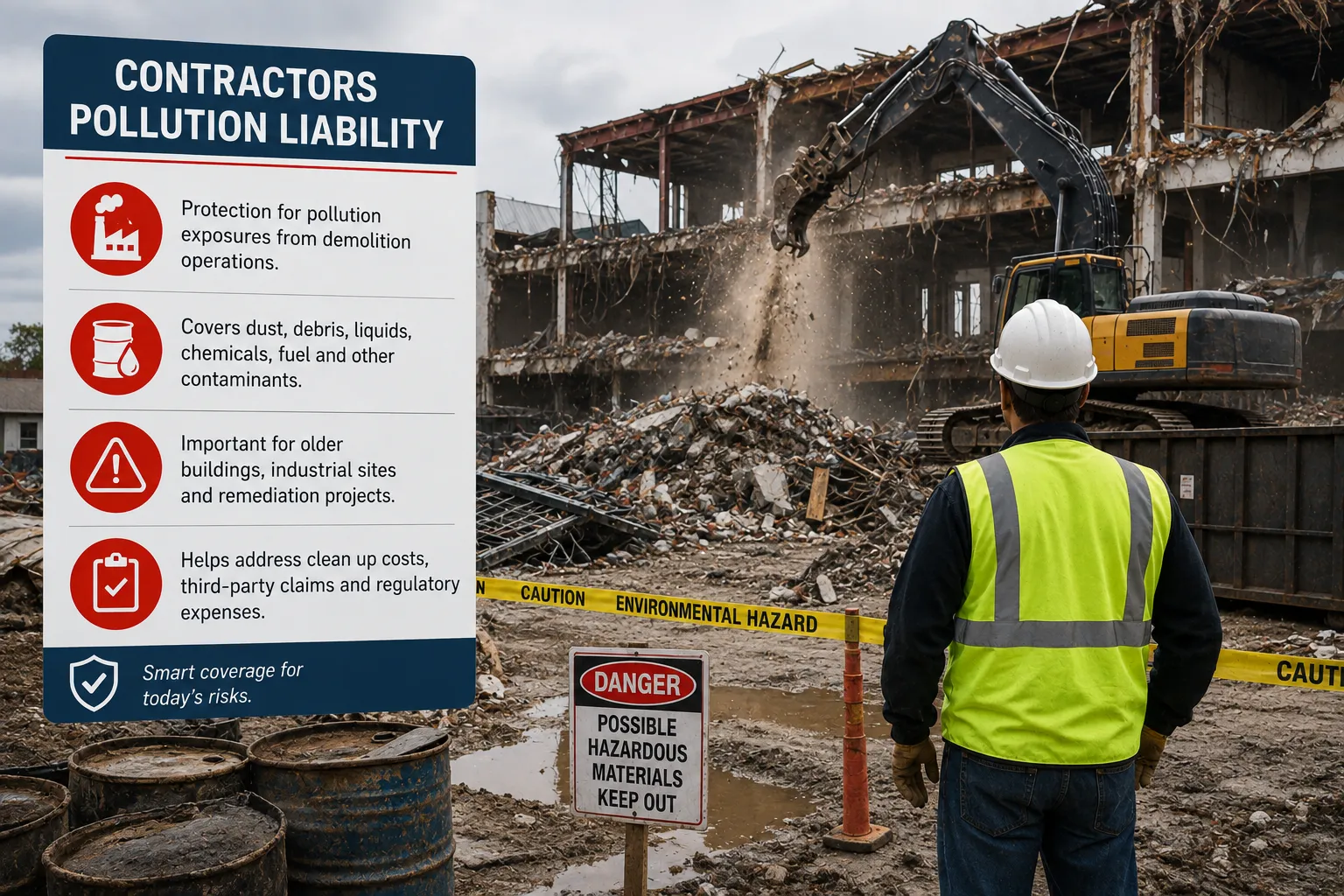
Demolition activities can also disturb existing contaminants or create environmental exposures involving dust, debris, liquids, fuel, chemicals, or other materials.
A standard general liability policy may not provide the pollution protection a demolition contractor assumes it does.
Contractors Pollution Liability coverage can be designed to address certain pollution-related exposures arising from contracting operations.
The appropriate coverage depends heavily on the type of demolition being performed.
For contractors working on older buildings, industrial properties, contaminated sites, or projects involving environmental remediation, this discussion becomes particularly important.
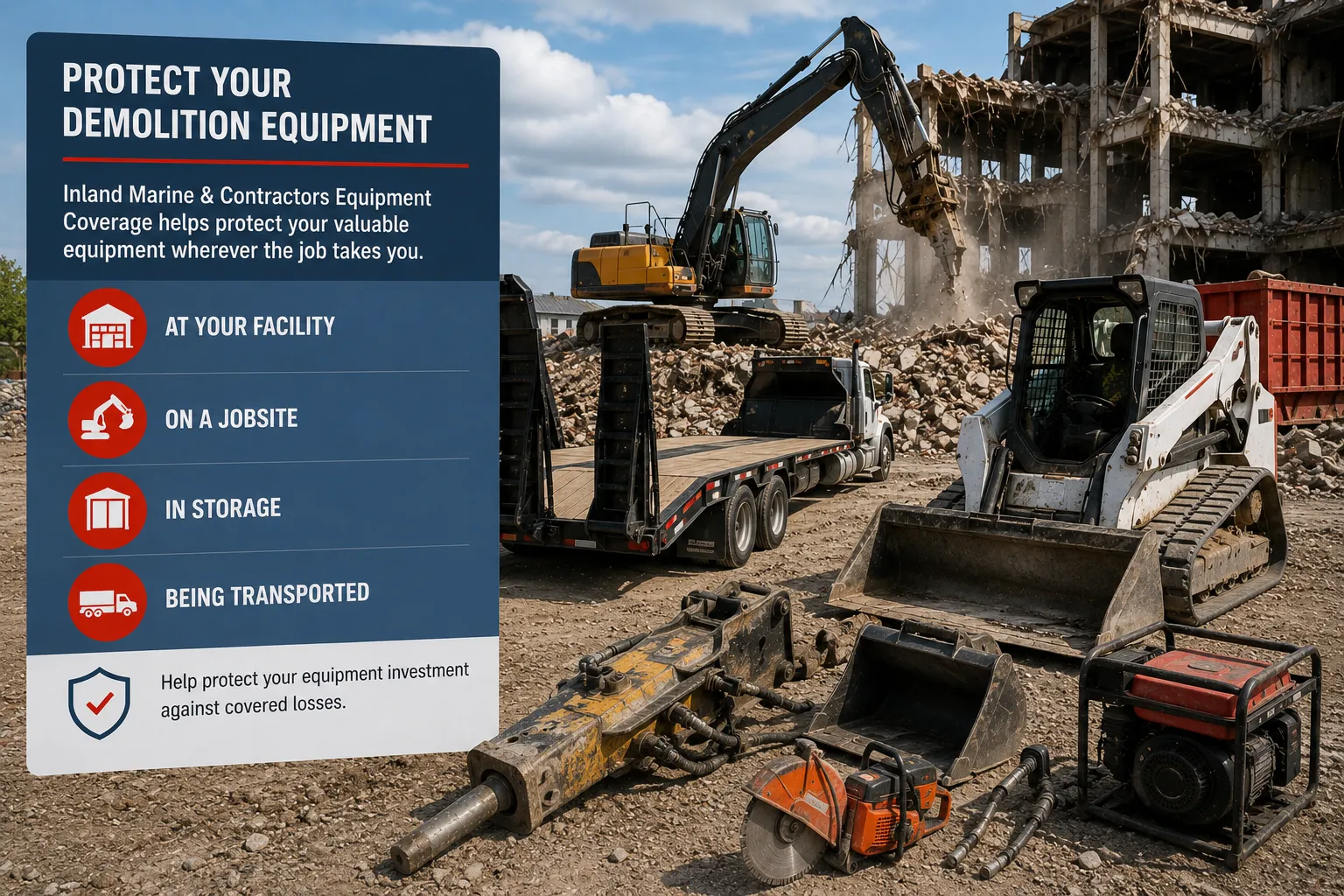
6. Inland Marine and Contractors Equipment Coverage
Demolition equipment isn’t cheap.
Excavators, skid steers, loaders, breakers, crushers, attachments, generators, tools, and other equipment can represent a significant investment.
Commercial property insurance isn’t always designed to follow equipment wherever it goes.
That’s where inland marine or contractors equipment coverage may become important.
Depending on the policy, coverage may help protect qualifying equipment against covered losses while it is:
- At your facility
- On a jobsite
- In storage
- Being transported
The exact equipment, ownership structure, values, transportation methods, and exposures should be discussed when building the insurance program.
7. Umbrella or Excess Liability Insurance
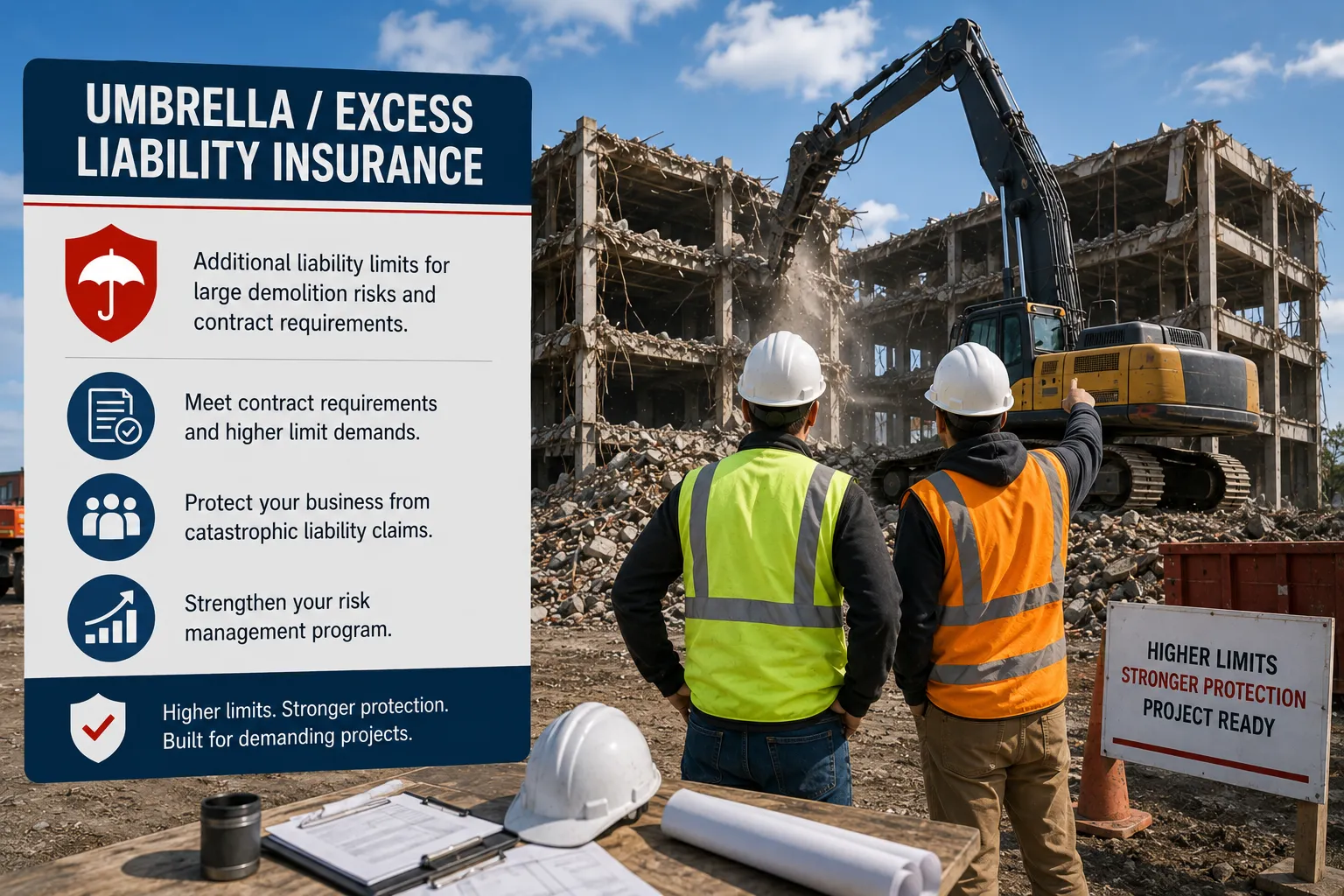
Some demolition projects require higher liability limits than a standard underlying policy provides.
A contract, general contractor, property owner, municipality, or other party may require significant limits before allowing a demolition contractor onto the project.
Commercial umbrella or excess liability coverage can provide additional limits over certain underlying policies, subject to the policy’s terms and structure.
For larger demolition contractors, this may be an important part of both risk management and contract compliance.
8. Additional Insured Requirements
If you’ve worked on commercial construction projects, you’ve probably seen this phrase:
Additional Insured.
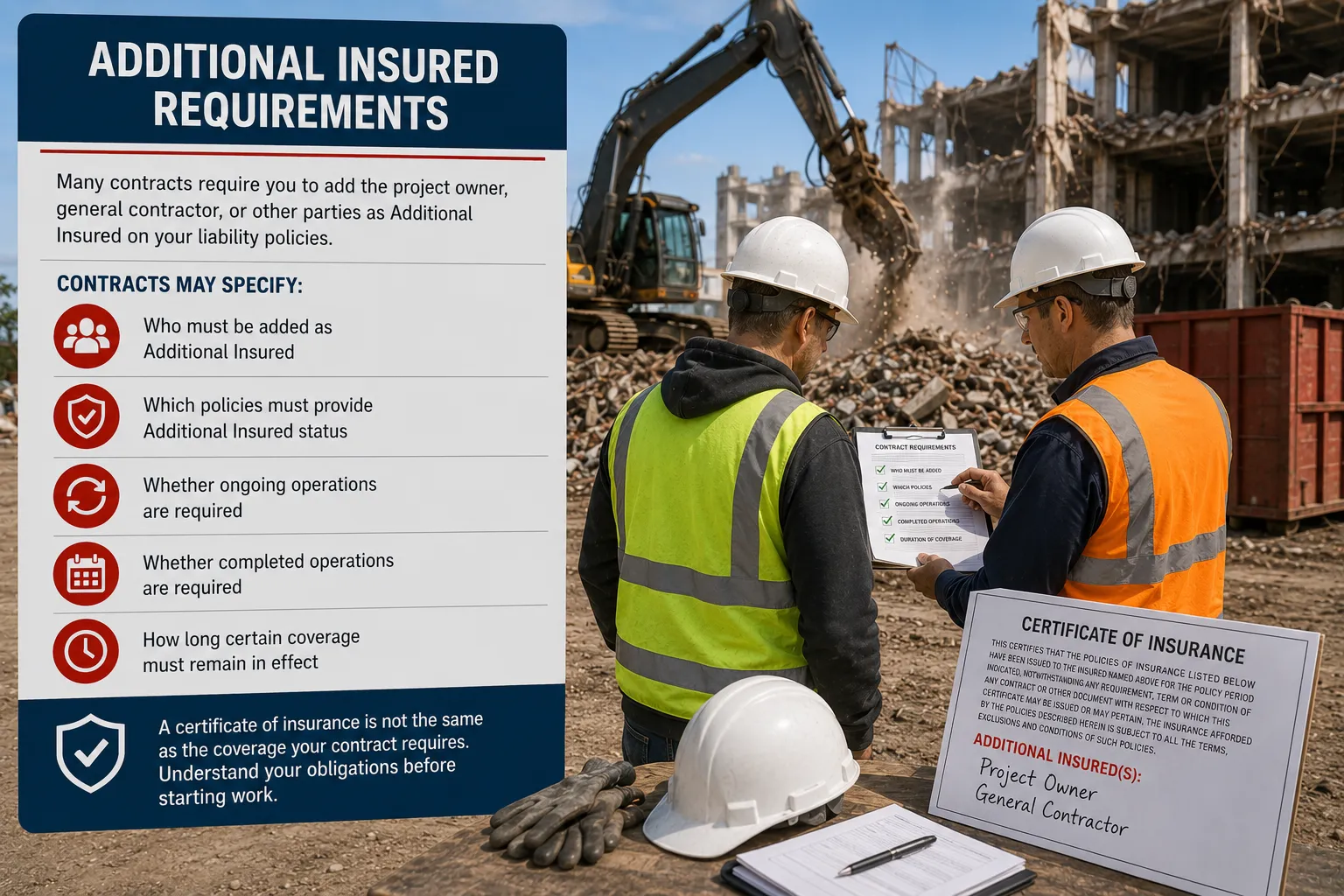
Project owners and general contractors frequently require subcontractors to add certain parties to their liability insurance.
But additional insured requirements can become complicated.
A contract may specify:
- Who must be added
- Which policies must provide additional insured status
- Whether ongoing operations are required
- Whether completed operations are required
- How long certain coverage must remain in effect
Simply producing a certificate of insurance doesn’t necessarily mean the underlying policy satisfies every contractual requirement.
Demolition contractors should understand what they’ve agreed to before beginning work.
9. Completed Operations Coverage
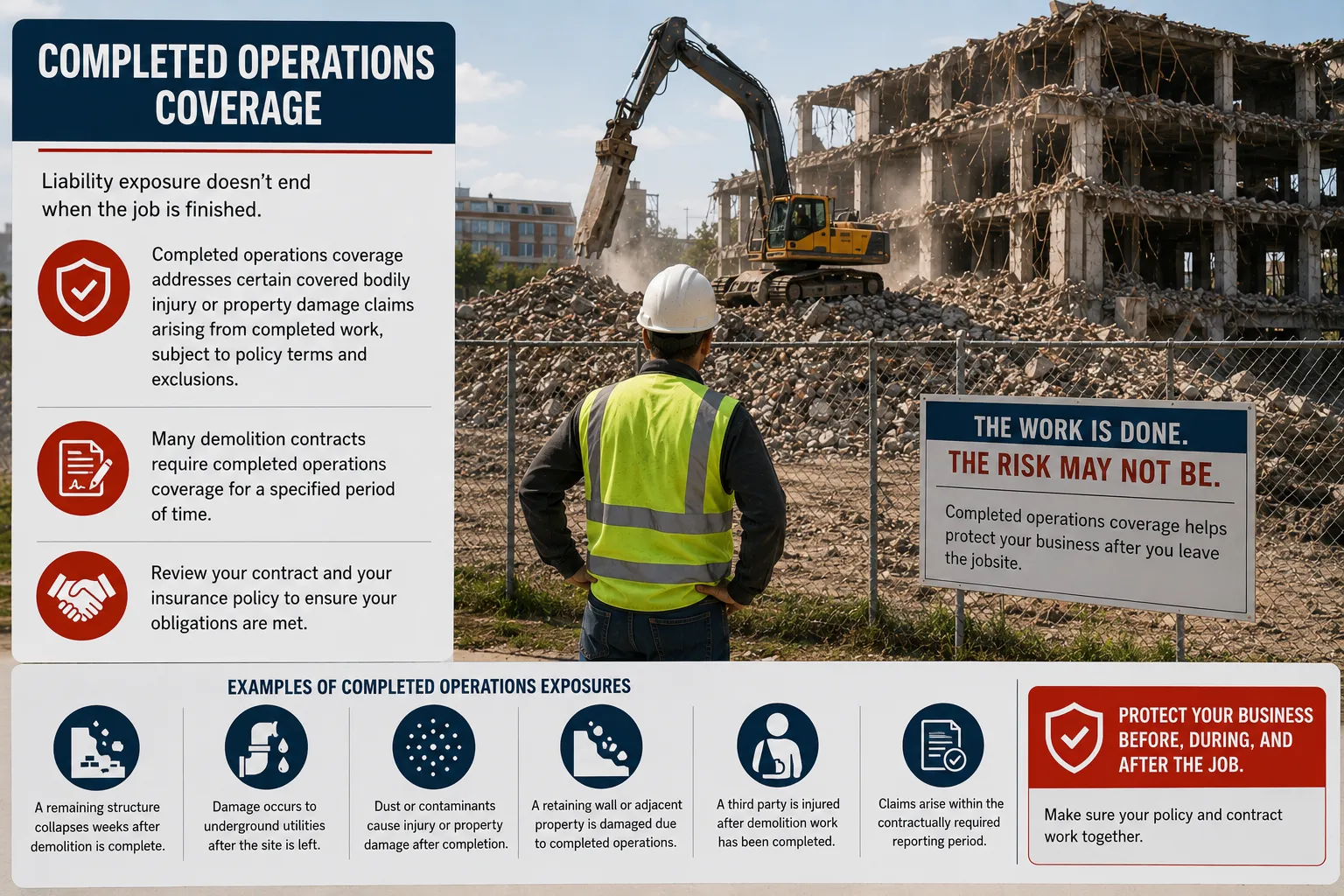
What happens after you leave the jobsite?
A contractor’s liability exposure doesn’t necessarily disappear when the work is finished.
Completed operations coverage addresses certain covered bodily injury or property damage claims arising from completed work, subject to policy terms and exclusions.
For demolition contractors, completed operations requirements may also appear in construction contracts.
This is another reason the insurance policy and the contract need to be evaluated together.
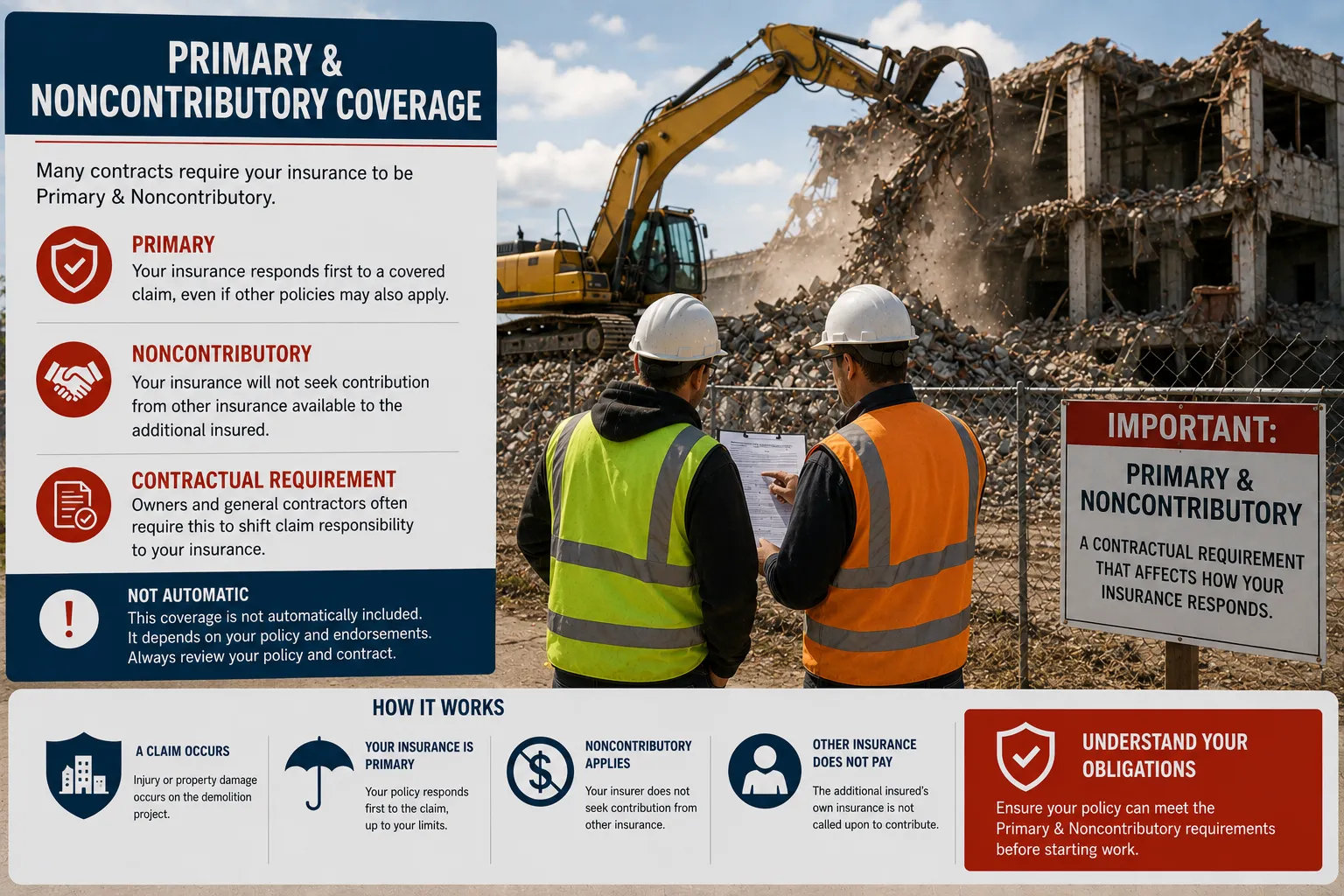
10. Primary and Noncontributory Coverage
Another phrase demolition contractors may encounter in contracts is:
Primary and Noncontributory.
Generally, this relates to how insurance policies respond when more than one policy could potentially apply to a claim.
A general contractor or property owner may require the demolition contractor’s insurance to respond on a primary basis without seeking contribution from certain other insurance.
Whether that requirement can be satisfied depends on the policy language and applicable endorsements.
This is not something contractors should assume is automatically included.
11. Waiver of Subrogation
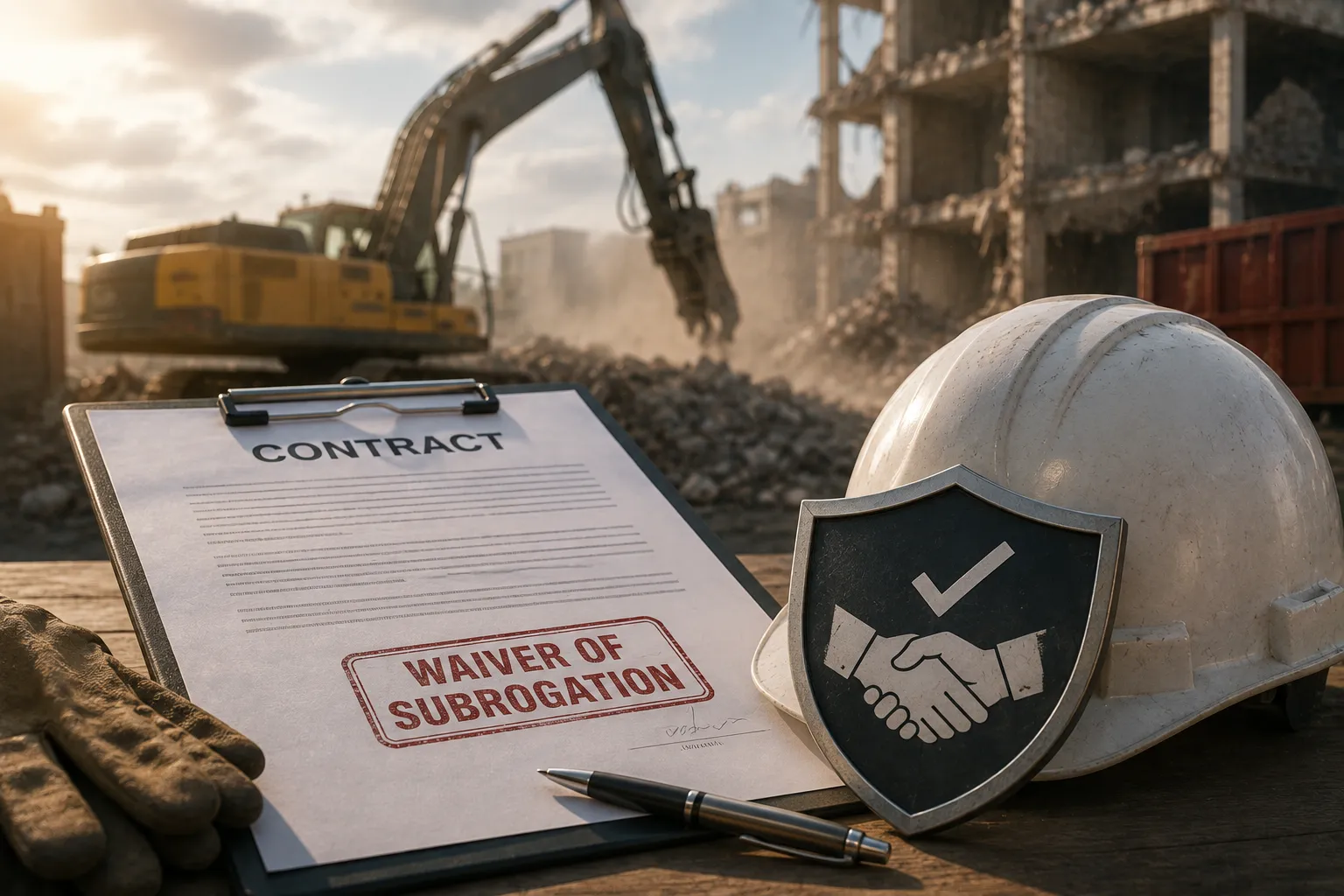
A construction contract may also require a waiver of subrogation.
In simple terms, subrogation generally refers to an insurance company’s ability, after paying a covered claim, to pursue another responsible party to recover some or all of that payment.
A waiver of subrogation can modify those rights under certain circumstances.
Because these provisions affect the relationship between contracts and insurance coverage, demolition contractors should discuss them with their insurance professionals before agreeing to contractual requirements.
What About Subcontractors?
Subcontracting can significantly affect a demolition contractor’s insurance exposure.
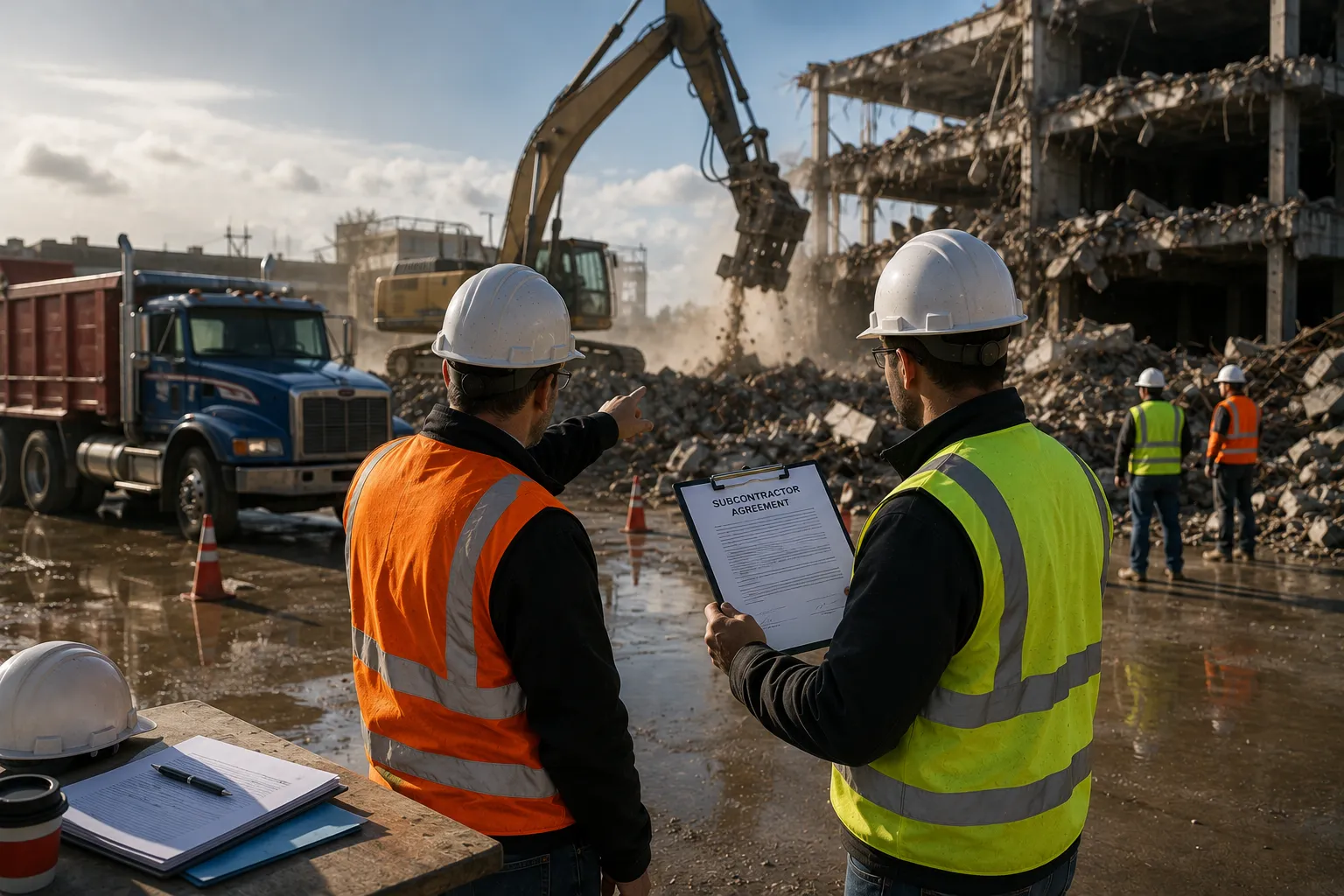
Imagine your company wins a demolition project but hires another contractor to perform part of the work.
Who is responsible if that subcontractor causes a loss?
The answer can depend on contracts, insurance policies, applicable law, and the circumstances of the incident.
That’s why insurance underwriters may want to know:
- What percentage of your work is subcontracted?
- What operations are subcontracted?
- Who are the subcontractors?
- What insurance limits do they carry?
- Do you obtain certificates of insurance?
- Are written subcontractor agreements used?
- Are additional insured requirements in place?
- How do you verify subcontractor coverage?
Subcontractor management isn’t just paperwork.
It can be a significant component of the demolition company’s overall risk.
Residential vs. Commercial Demolition Insurance
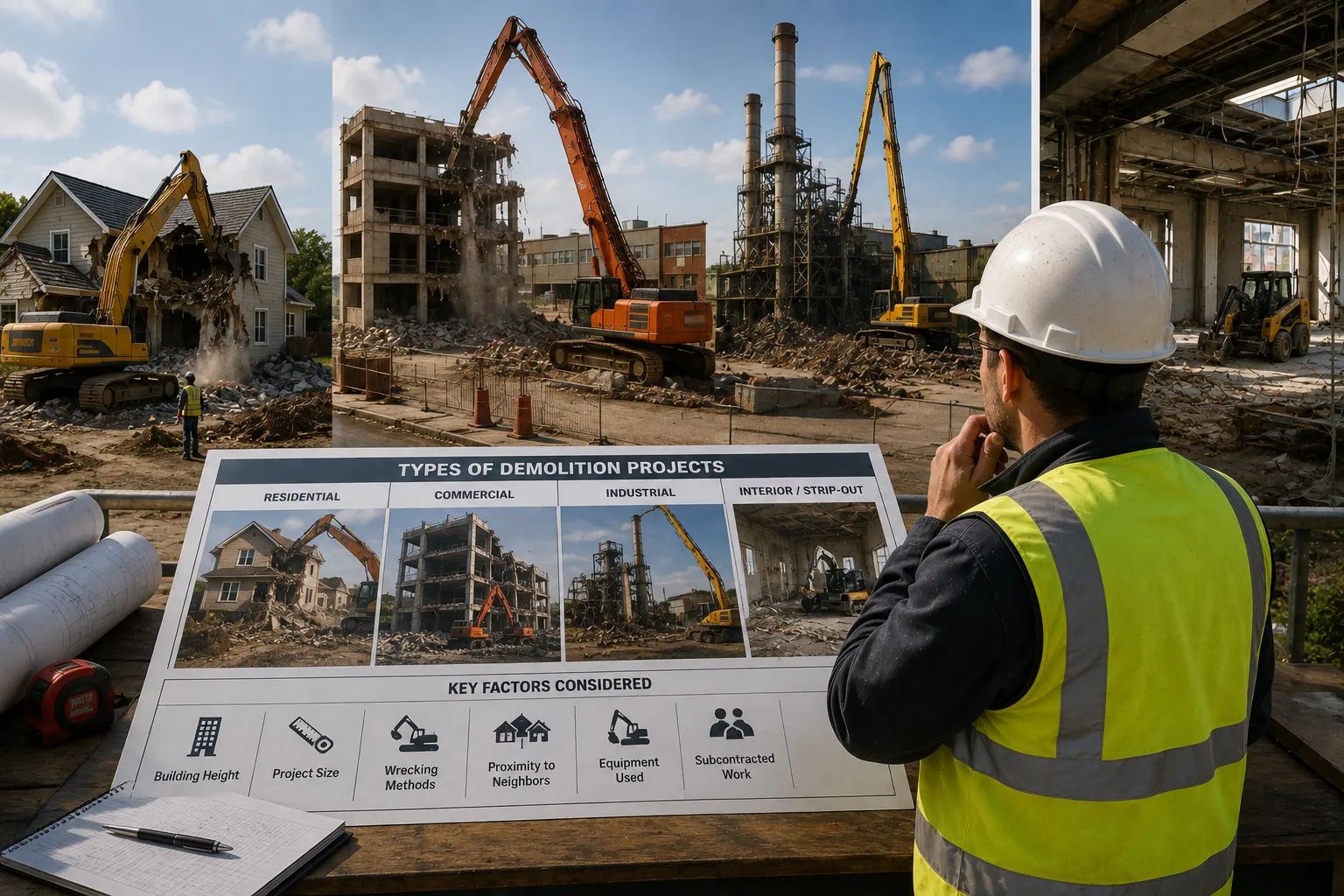
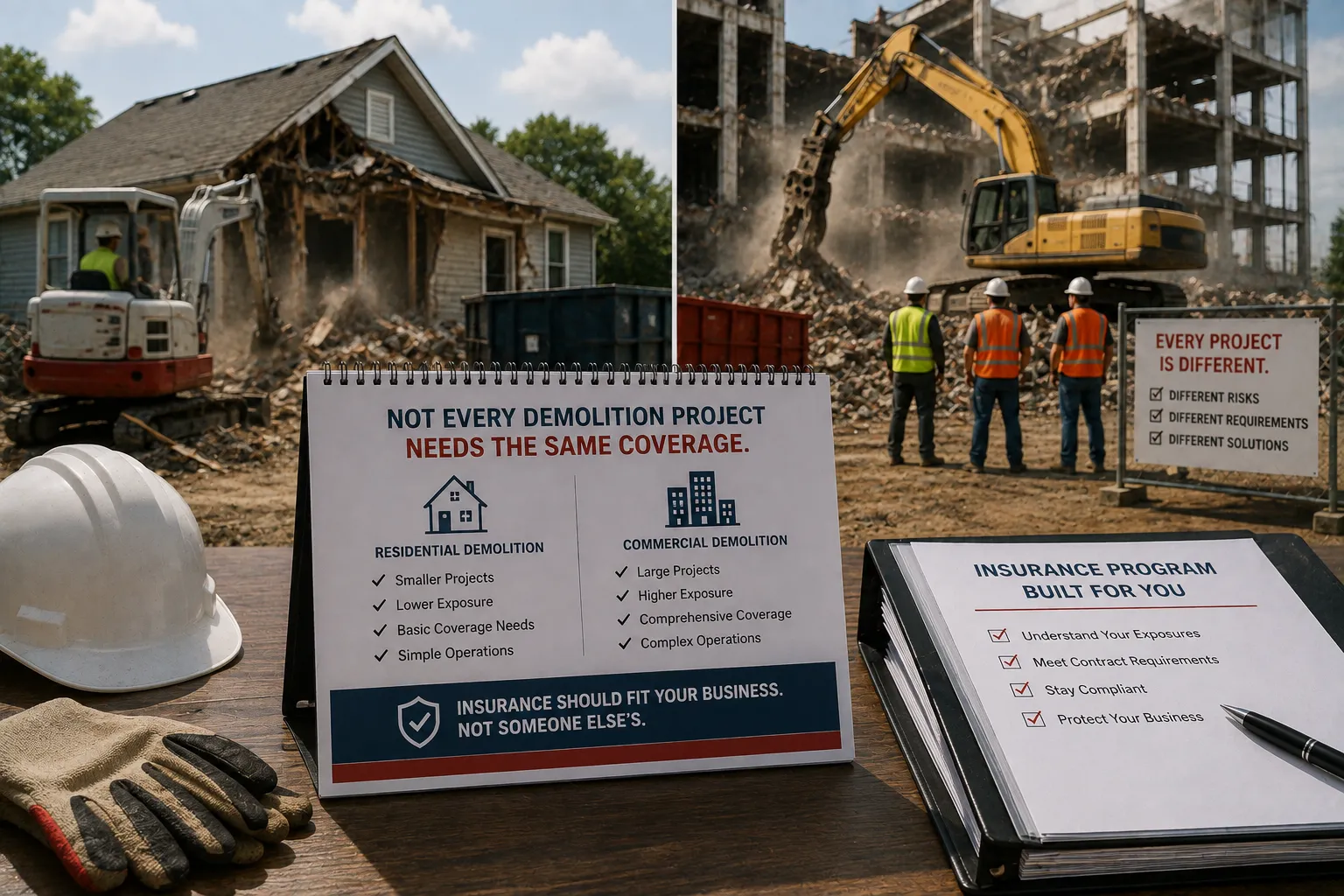
Not all demolition contractors perform the same work.
A contractor tearing down single-family homes presents a different risk profile than a contractor demolishing large commercial or industrial structures.
Likewise, an interior strip-out contractor may have very different exposures than a company performing complete structural demolition.
Underwriters may consider factors such as:
- Residential vs. commercial work
- Maximum building height
- Maximum project size
- Structural demolition
- Interior demolition
- Industrial demolition
- Excavation
- Blasting
- Wrecking methods
- Proximity to neighboring structures
- Equipment used
- Subcontracted work
This is why accurately describing your operations is so important.
What Insurance Do You Need Before Bidding a Demolition Project?
Don’t wait until after winning the project to read the insurance requirements.
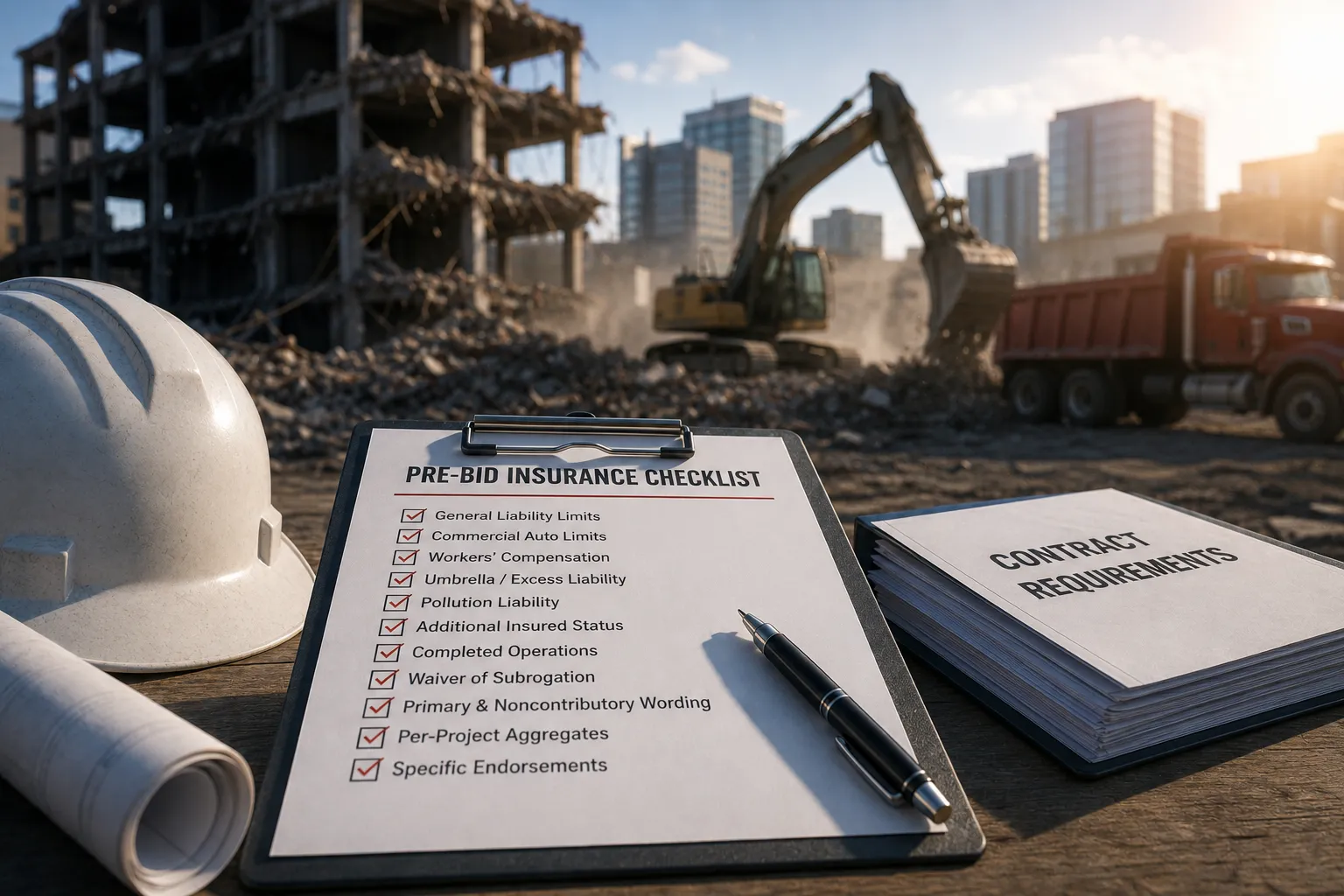
Before submitting a bid, review the contract specifications carefully.
Look for requirements involving:
- General liability limits
- Commercial auto limits
- Workers’ compensation
- Umbrella or excess liability
- Pollution liability
- Additional insured status
- Completed operations
- Waiver of subrogation
- Primary and noncontributory wording
- Per-project aggregates
- Specific endorsements
An inexpensive insurance policy isn’t inexpensive if it prevents you from qualifying for the projects your company wants.
Your insurance program should reflect the work you’re pursuing.
What Do Demolition Insurance Underwriters Want to Know?
One of the best ways to improve the insurance process is to arrive prepared.
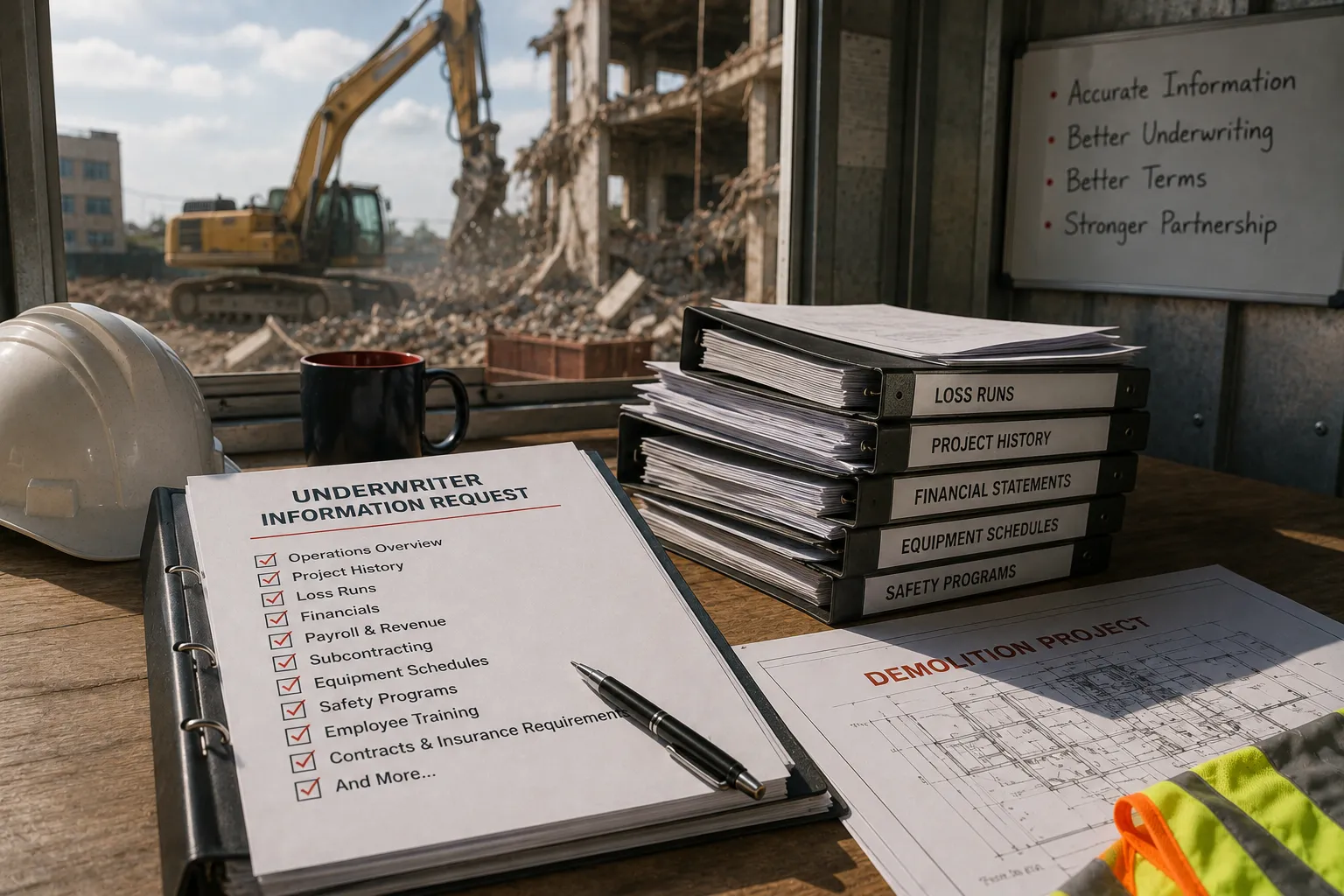
Demolition insurance underwriters may want substantially more information than you’d provide for a low-risk business.
Depending on the account, information could include:
- Completed insurance applications
- Description of operations
- Project history
- Current and previous loss runs
- Annual revenue
- Payroll
- Subcontracting costs
- Maximum project size
- Geographic territory
- Equipment schedules
- Safety programs
- Employee training procedures
- Financial statements
- Key employee or management résumés
- Sample subcontractor agreements
- Certificates and insurance requirements
- Equipment maintenance procedures
Why so much information?
Because an underwriter is trying to understand the actual business.
Two demolition companies with identical revenue can represent completely different risks.
Your Loss History Matters
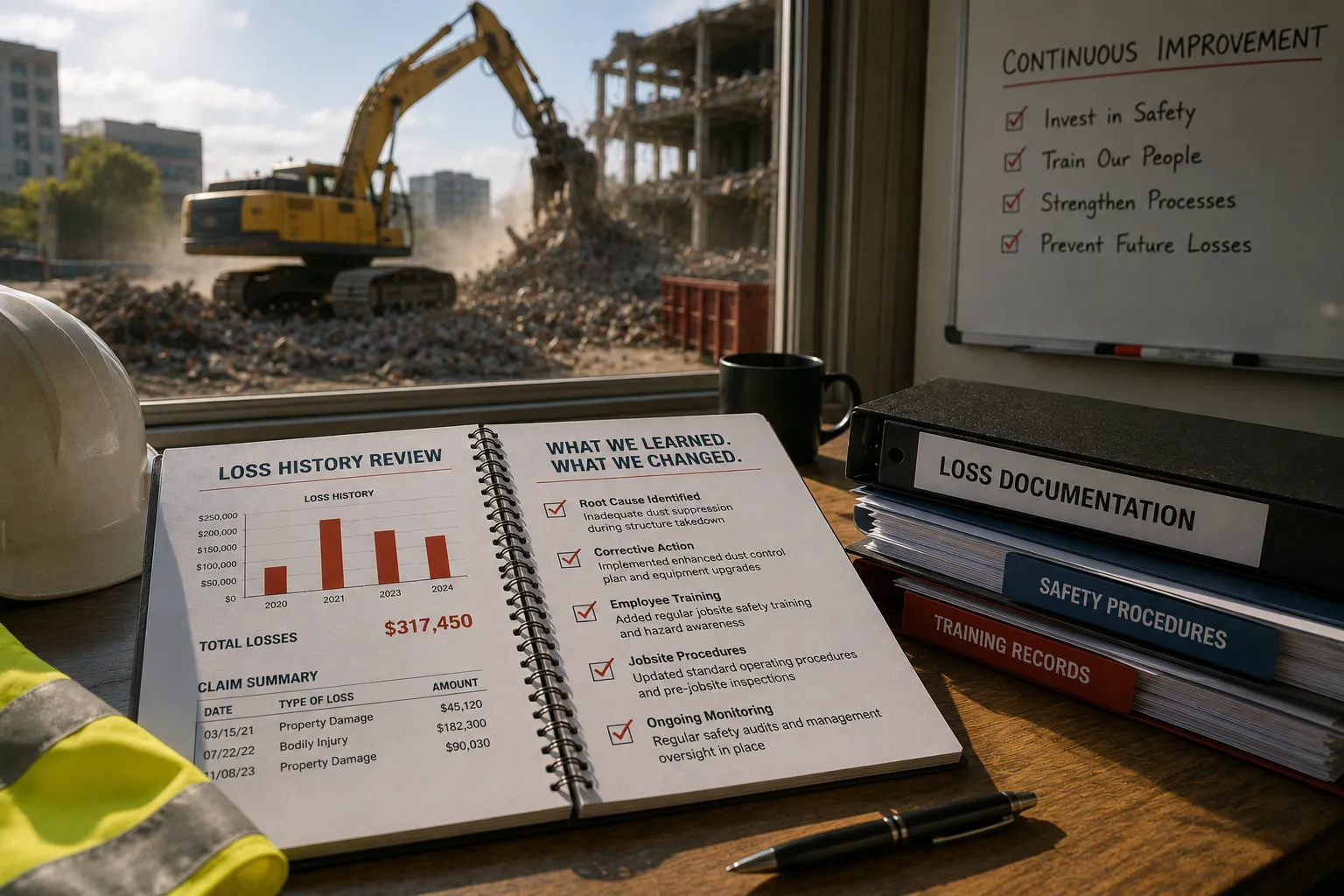
Previous insurance claims can influence how an underwriter evaluates a demolition contractor.
But the number on the loss run isn’t always the entire story.
If your company experienced a significant loss, be prepared to explain:
What happened?
Why did it happen?
What did you change afterward?
An experienced underwriter may want to see evidence that the business learned from the event and implemented procedures intended to prevent a similar incident.
A strong explanation and documented corrective action can provide much more useful context than simply submitting a loss run without explanation.
Your Safety Program Can Affect More Than Employee Injuries
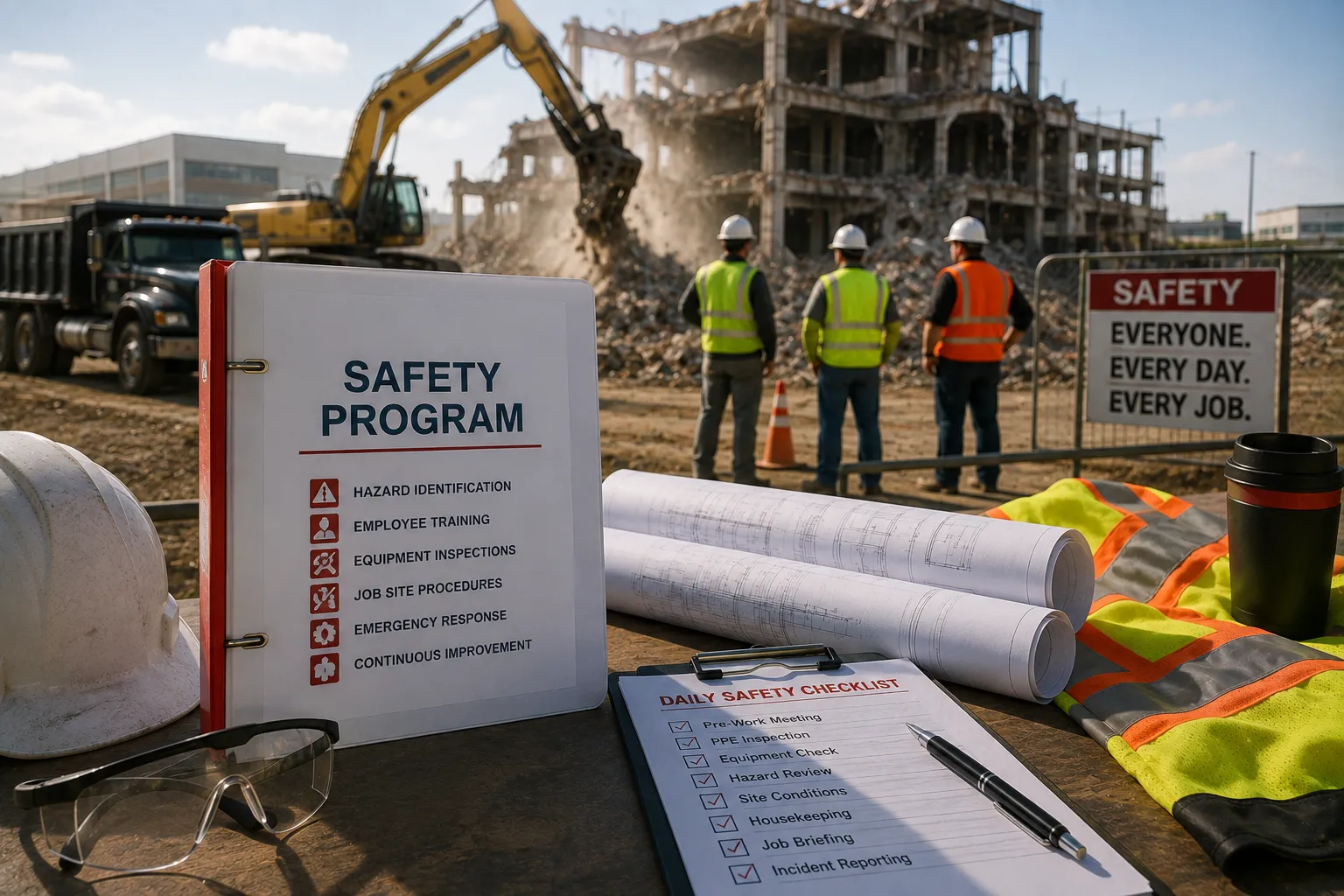
A written safety program shouldn’t exist solely because an insurance application asks whether you have one.
Good safety procedures can affect:
- Employees
- Customers
- General contractors
- Neighboring properties
- Equipment
- Project schedules
- Insurance claims
- Your reputation
Demolition contractors should be able to demonstrate that safety is part of how the business operates—not just something written in a binder.
Why Specialty Demolition Insurance Experience Matters
Many insurance professionals can insure a contractor.
Far fewer regularly work with demolition risks.
That difference matters because demolition contractors frequently encounter specialized underwriting questions, contract requirements, exclusions, and coverage concerns.
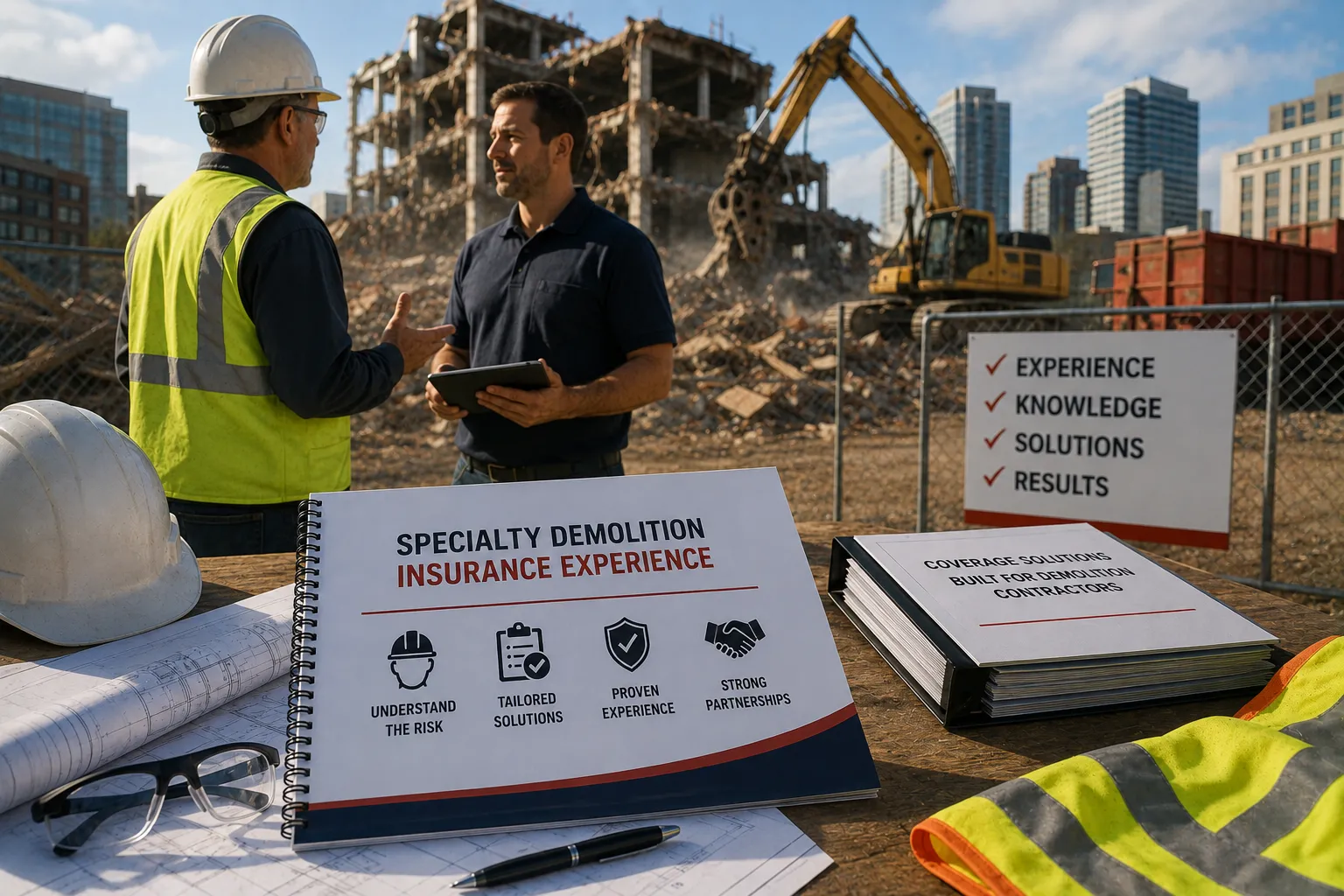
Apollo General Insurance Agency has more than 60 years of experience in specialty commercial insurance and offers dedicated demolition contractor insurance programs.
Apollo’s demolition programs can accommodate operations ranging from residential and commercial tear-downs to interior strip-outs, depending on underwriting eligibility.
That experience helps Apollo understand both sides of the conversation:
What does the demolition contractor actually do?
And:
What does the insurance carrier need to understand before agreeing to insure it?
Preparing for a Demolition Contractor Insurance Quote
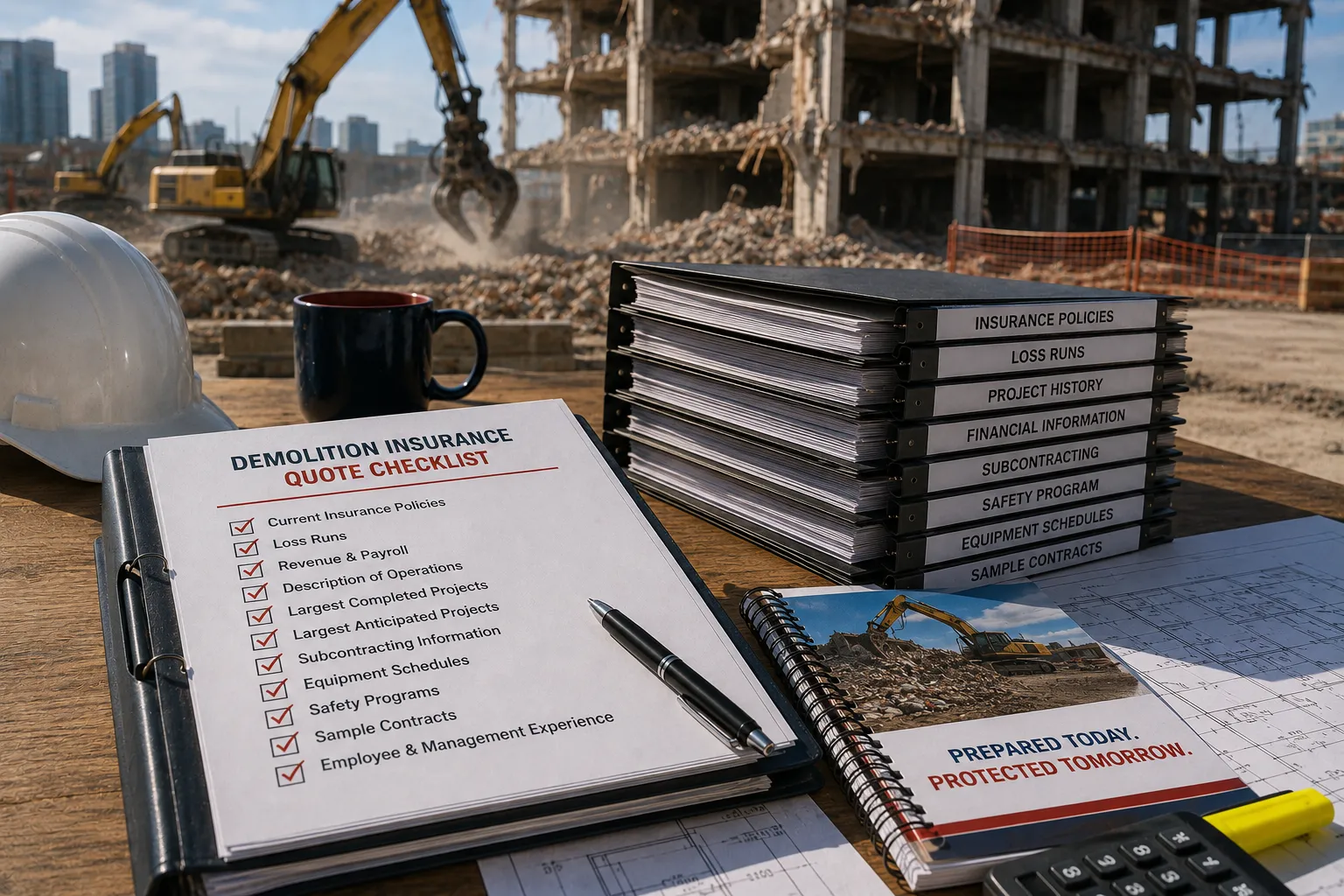
Before requesting a quote, gather as much information as possible.
Start with:
- Current insurance policies
- Current and previous loss runs
- Revenue and payroll information
- Description of demolition operations
- Largest completed projects
- Largest anticipated projects
- Subcontracting information
- Equipment schedules
- Safety programs
- Sample contracts
- Employee and management experience
Complete information can help underwriters understand your company more accurately.
And in specialty insurance, details matter.
Does Every Demolition Contractor Need Every Coverage Listed Here?
No.
A two-person residential demolition operation doesn’t necessarily need the same insurance program as a contractor performing multimillion-dollar commercial projects.
Likewise, insurance requirements differ by state, contract, project, client, operations, and company structure.
That’s why a demolition insurance program should be built around the contractor rather than copied from another business.
The important thing is understanding your exposures before a loss—or a contract requirement—reveals a gap.
Demolition Contractor Insurance From Apollo General Insurance Agency
Demolition isn’t a sideline class of business for Apollo General Insurance Agency.
It’s one of Apollo’s specialty programs.
Apollo works with demolition risks involving residential tear-downs, commercial tear-downs, interior strip-outs, and other eligible demolition operations.
If you’re a demolition contractor—or an insurance broker trying to place a demolition account—the first step is understanding the operation in detail.
Learn more about Apollo’s demolition contractor insurance program at Apollo General Insurance Agency.

Conclusion
So, what insurance does a demolition contractor need?
There isn’t one universal answer.
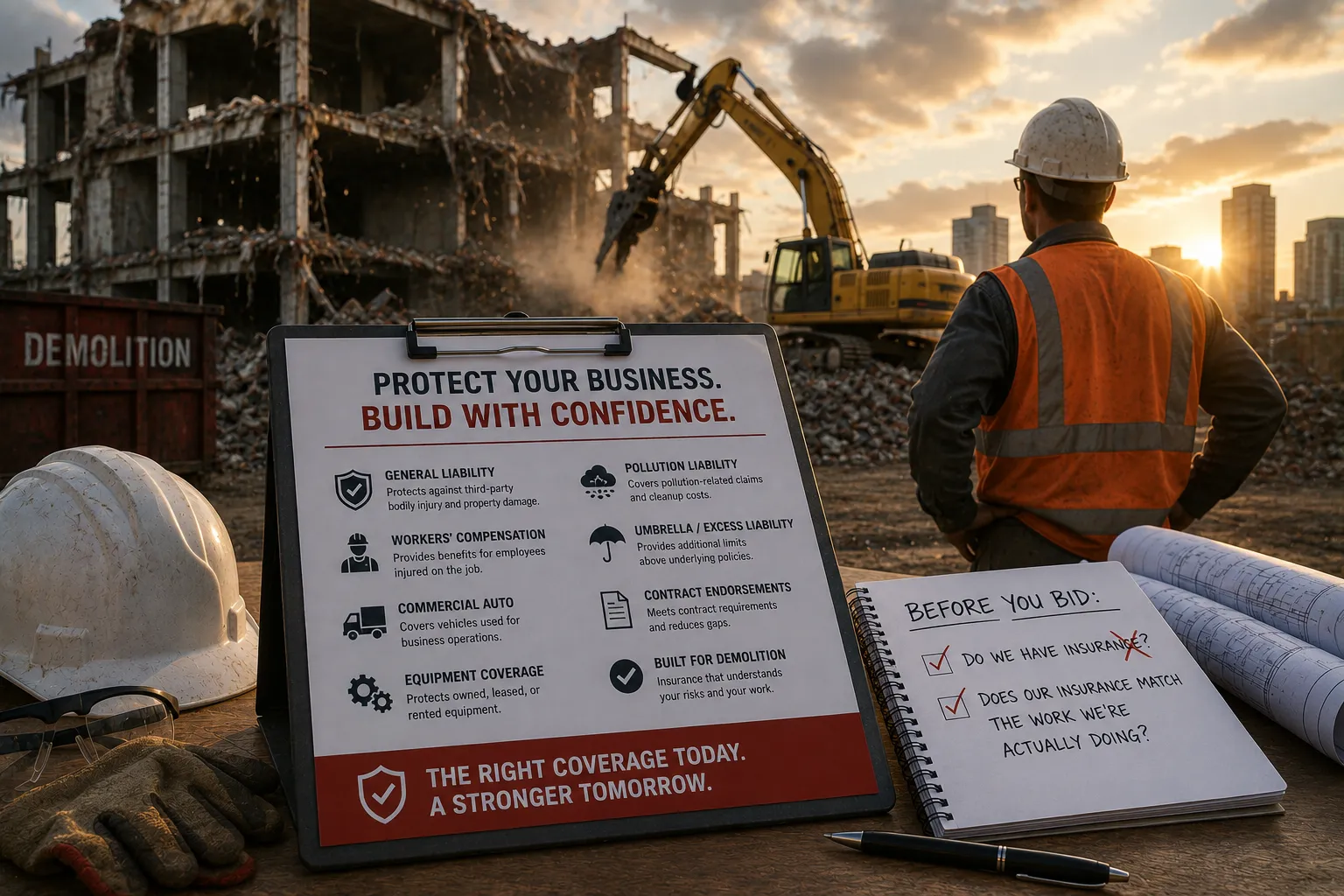
General liability may be the foundation, but a complete insurance program could also involve workers’ compensation, commercial auto, pollution liability, contractors equipment coverage, umbrella or excess liability, and specialized endorsements addressing contractual and operational exposures.
More importantly, demolition contractors need insurance that actually understands demolition.
The cheapest contractor policy won’t provide much value if exclusions, limitations, or missing endorsements prevent it from responding as expected—or keep you from qualifying for the projects you want.
Before your next bid, don’t just ask:
“Do we have insurance?”
Ask:
“Does our insurance match the work we’re actually doing?”
Frequently Asked Questions About Demolition Contractor Insurance
1. What insurance does a demolition contractor need?
Depending on operations and applicable requirements, demolition contractors may need general liability, workers’ compensation, commercial auto, contractors equipment, pollution liability, and umbrella or excess liability coverage.
2. Is demolition covered by normal contractor general liability insurance?
Not necessarily. Demolition presents specialized exposures, and some contractor insurance programs may exclude or restrict certain demolition operations.
3. What is XC&U insurance?
XC&U refers to explosion, collapse, and underground exposures. Contractors should understand how their liability policy addresses these risks.
4. Why is collapse coverage important for demolition contractors?
Structural collapse is an inherent concern in demolition operations, making it important to understand any relevant exclusions or limitations within a liability policy.
5. Do demolition contractors need pollution liability insurance?
Some demolition operations may create pollution exposures that aren’t adequately addressed by standard general liability insurance. The need depends on the work being performed.
6. Do demolition contractors need workers’ compensation?
Requirements vary by state and business circumstances, but demolition contractors with employees commonly need workers’ compensation coverage.
7. Does demolition contractor insurance cover subcontractors?
Coverage depends on the policy, contracts, operations, and circumstances. Contractors should have appropriate subcontractor risk-management procedures rather than assuming subcontractors are automatically covered.
8. What insurance should my demolition subcontractors carry?
Requirements depend on the project and operations. General liability, workers’ compensation, commercial auto, and other coverage may be appropriate.
9. What is an additional insured?
An additional insured is a person or organization provided certain coverage rights under another party’s insurance policy through applicable policy language or endorsements.
10. What does primary and noncontributory mean?
It generally relates to the order in which applicable insurance policies respond to a covered claim and whether contribution is sought from certain other insurance.
11. What is a waiver of subrogation?
A waiver of subrogation can modify an insurer’s ability to pursue recovery from certain parties after paying a covered claim, subject to policy terms and applicable requirements.
12. What is completed operations coverage?
Completed operations generally addresses certain liability claims arising from work after the contractor has completed the operation.
13. Does a demolition contractor need commercial auto insurance?
If vehicles are owned or operated for business purposes, commercial auto insurance may be necessary depending on the circumstances.
14. How is demolition equipment insured?
Contractors equipment or inland marine coverage may be used to insure qualifying mobile equipment and tools against specified covered losses.
15. Does demolition insurance cover excavators?
Contractors equipment coverage may cover scheduled excavators and other qualifying equipment depending on the policy.
16. Does demolition contractor insurance cover damage to neighboring buildings?
Potential coverage depends on the cause of loss, applicable policy, exclusions, endorsements, and circumstances. This is an important exposure to discuss when evaluating demolition liability insurance.
17. How much does demolition contractor insurance cost?
There is no single price. Premiums can depend on revenue, payroll, operations, project sizes, subcontracting, geographic territory, loss history, limits, equipment, and other underwriting factors.
18. What documents do I need for a demolition insurance quote?
Underwriters may request applications, loss runs, financial information, project history, safety information, subcontractor agreements, equipment schedules, management experience, and other documents.
19. Can previous claims make a demolition contractor uninsurable?
Not necessarily. Underwriters may consider the type and severity of previous claims as well as corrective actions taken afterward.
20. Does Apollo General Insurance Agency specialize in demolition contractors?
Yes. Apollo General Insurance Agency offers specialty demolition contractor insurance programs for eligible operations, including residential and commercial tear-downs and interior strip-outs.